Art
Leo repainted: the finish leaves 3D and goes back to drawing
The three-dimensional model was finished and still did not fit on screen. The way out was not choosing between 3D and 2D but splitting the jobs: 3D moves, 2D draws. Seventy frames repainted one by one for a single walk cycle.
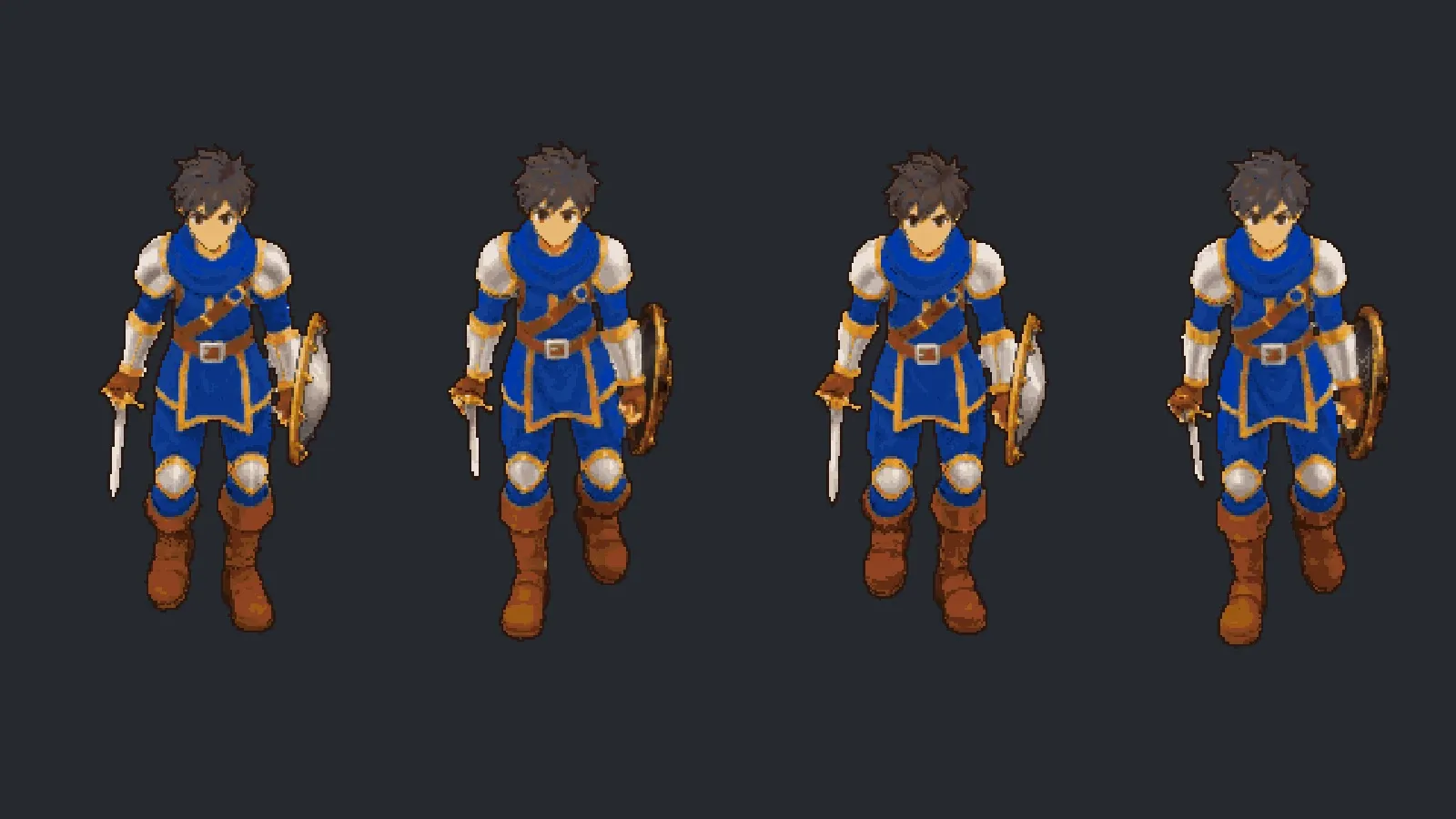
Leo had been through three months of rebuilds. The last one remade him entirely in three dimensions: a new model, eight directions that are headings on the map rather than anatomical sides, and a ninety-three-frame sword draw that took a week. That whole chain, with the versions that fell by the wayside, is in How Leo came to look like Leo.
It was finished. And putting it into the game surfaced what no review had caught.
Update, 7 October. This entry’s conclusion — splitting the work between 3D and a 2D repaint — did not survive. The repaint fell revision after revision, and the right road turned out to be a different one: resolve everything in Blender and paint nothing on top. The whole thing, mistake included, is in The sword draw, in eight directions.
On screen it did not fit
On its own it was fine. Next to the rest of Ascension — the citadel, the bestiary, the portraits — it read as a shrunken 3D model, not as a drawing. The movement was right and the finish belonged to another game.
Measured, the mismatch turned out to be proportions. Aligning the silhouettes by the contact point against the canon artwork: the canon head takes between 18 % and 19.4 % of the height, the model’s between 12 % and 16.9 %; the shoulders, up to 60 % wider. That is geometry, and geometry is not fixed by painting on top, because the sprite’s cutout comes from the 3D silhouette.
And underneath there was a worse drift, which took me a while to admit. From rescuing piece after piece out of the render — the sword, the shield, the scabbard, the pauldrons, the right forearm — 3D had become the design, and the drawing was only laying a coat of style over it.
Splitting the jobs
The way out was not choosing between 3D and 2D, but giving each one its own job.
3D keeps what it does well and what costs a fortune by hand: the movement, the perspective, what covers what, and which face of the shield is visible at every instant. None of that gets drawn.
And the finish is redone entirely in 2D, frame by frame. It is not a filter over the render nor a patch on the pieces that fail: every frame is repainted in the game’s style, with the 3D pose underneath as a guide. The style comes from a model trained only on Ascension’s own canon artwork — forty-nine sheets of mine, none of them generated — so it cannot look like anything but my drawings.
Seventy frames per direction at thirty a second: a 2.33-second cycle. Across the eight directions, five hundred and sixty poses for walking alone.
And the single frame, which is the Leo that will be in the game:
What the shield taught
Almost all the work of these weeks went into one piece.
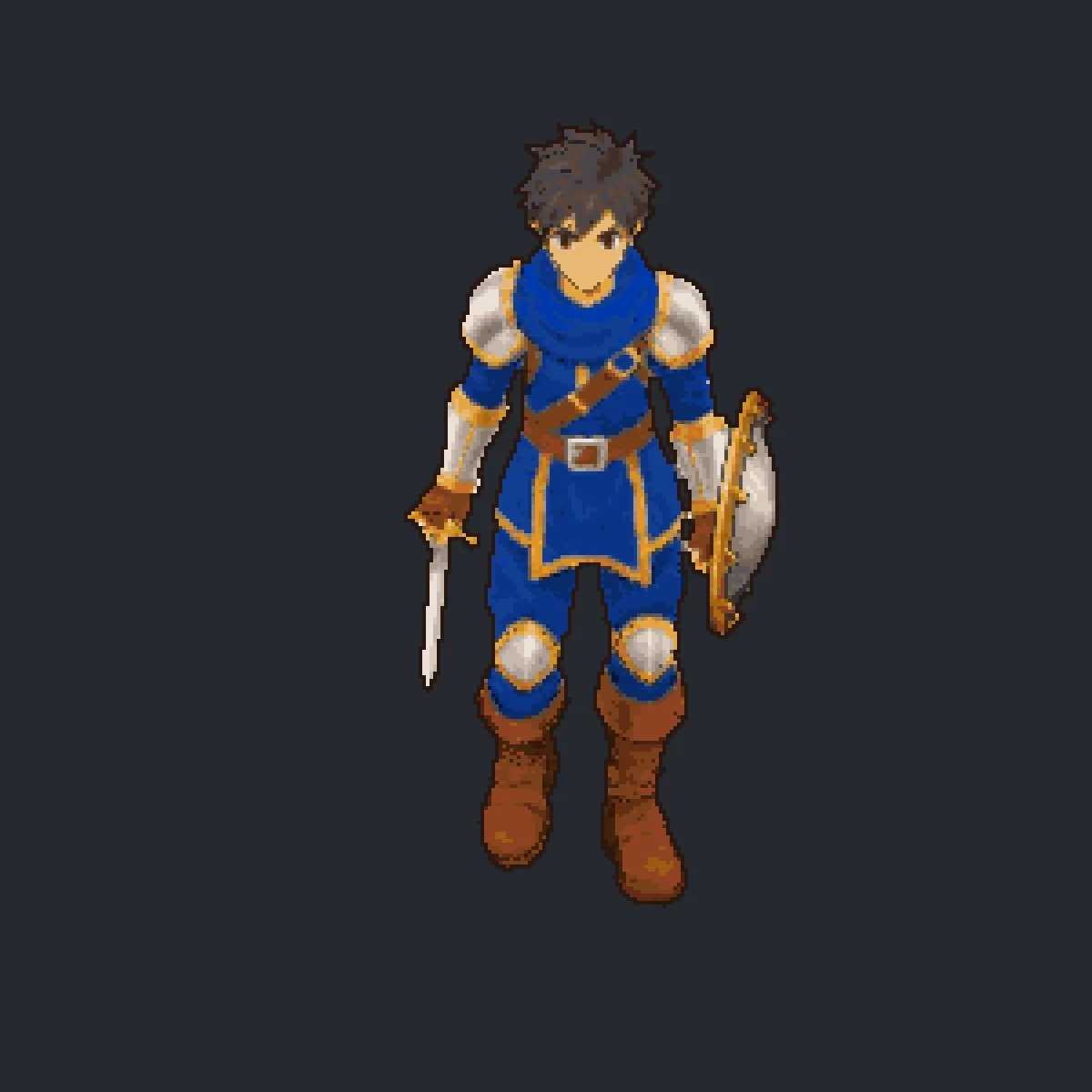
First, the defect you cannot see. Frame by frame the shield was fine; at game speed it flickered like a mirror, because every frame painted it with a slightly different shine. Hence a rule I no longer let go of: this is judged in motion, never on a still.
Then, the obvious mistake. I had assumed the shield was steel, and facing south what you see is the inside: wood, straps and a thick brass ring. The render said so itself, and I read it wrong for days.
And the finishing touch: when the disc goes almost edge-on, the brass ring flattens to a pixel and turns grey. The edge had to be drawn separately, with its thickness, and the chain taught when to use it.
What is missing
South is approved: the seventy frames of the cycle, still with four colour jumps in the brass I would like to remove. The other seven directions are not. In the east profile the sword, the hair, the face, the pauldrons and the bracers dance from frame to frame, which is exactly the defect south took a week to shake off.
And this finish still has to reach the rest of the animations. Walking is the first, not the only one.
What I take from it
The lesson of this delivery is almost the opposite of the last one, and it fits with it. September’s was that a technical validation is not an artistic approval. This one is the same look from the other side: the tool cannot end up being the design.
3D came in to save work and ended up deciding how the game looked. It works the moment you give it a concrete job — move, occlude, hold the perspective — and take back the one that was never its own.