Art
The slime needed a new body
In September I wrote that if the slime ever needed a new body, we'd change the body. Three weeks later it needed one. This is the second life of the game's first enemy, and what it cost to make a gel move like a gel.
Three weeks ago I published how the game’s first enemy stopped being a green hexagon and became a slime. That entry ended with a line I wrote without expecting to be held to it so soon:
If the slime needs a different body tomorrow, you change the body.
Well, it needed one.
Why redo something that already worked
July’s slime wasn’t bad. It was finished: nine animations, eight directions, approved and in play ever since.
What happened is that in between, the chain that produced Leo, the goblin, the wolf and the dragon got built. And when the slime stood next to any of them, you could tell it came from somewhere else. Not in quality: in provenance. A bestiary where one creature is made differently doesn’t read as a bestiary, it reads as a collection.
So the question wasn’t whether the slime was good. It was whether I wanted to defend that difference for the two years still to come.
A creature with no bones
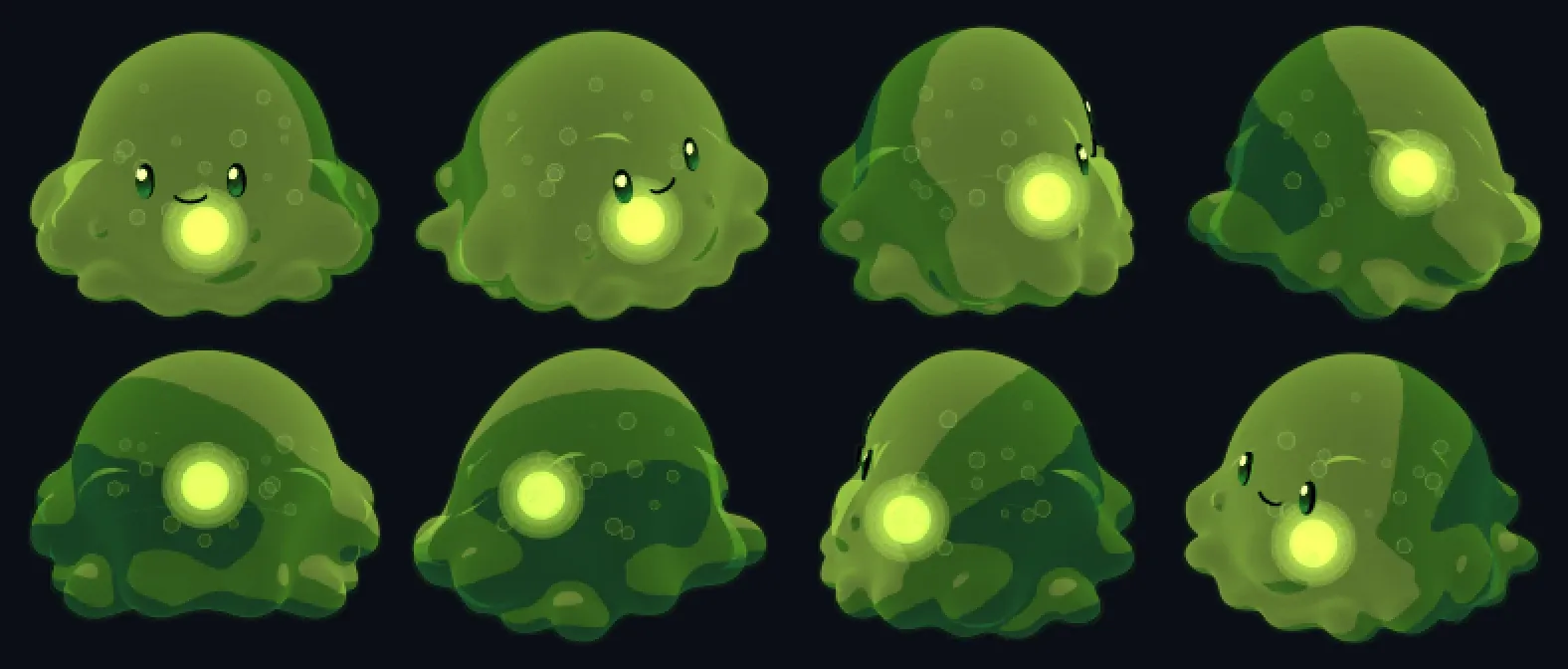
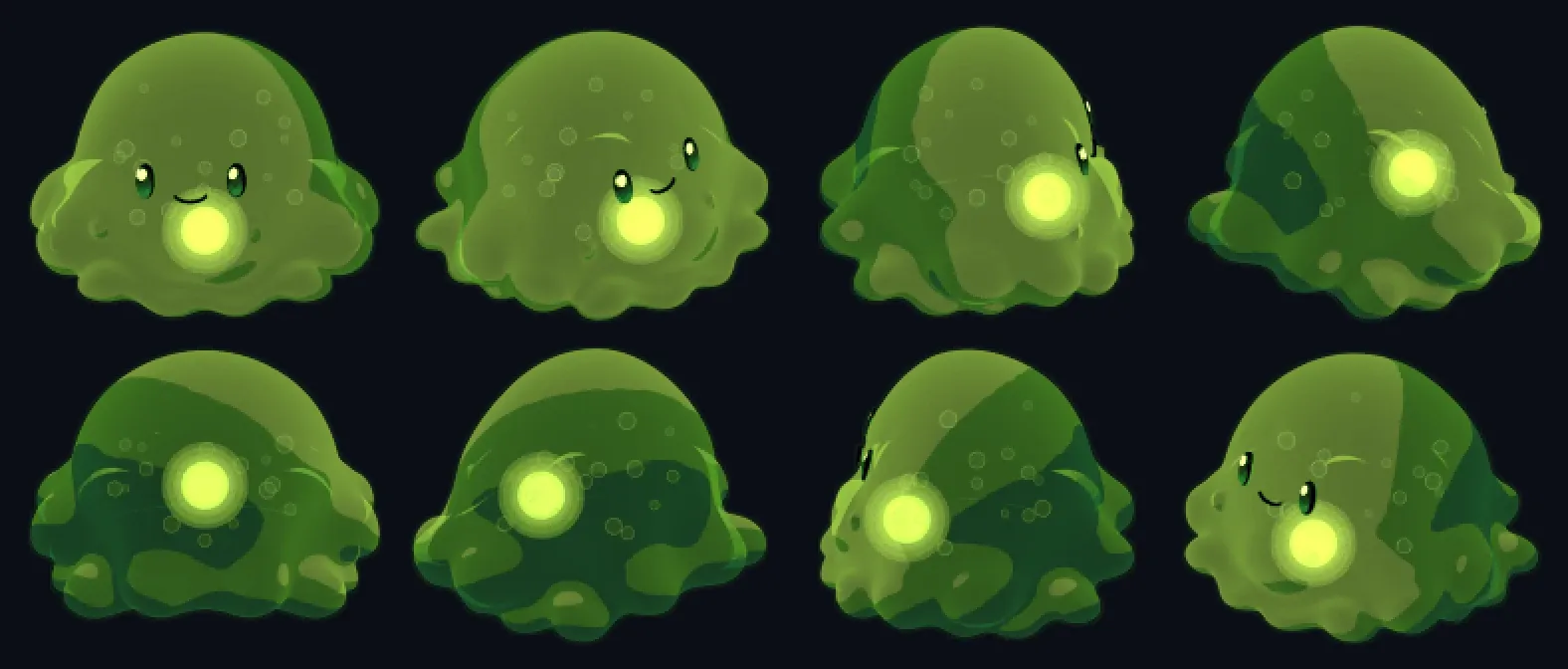
The model arrived as a single mesh with no skeleton. For any other creature that’s a problem; for this one it turned out to be correct.
A slime has no bones. It has no elbows to bend and no hips to rotate: it has volume that moves. So there’s no skeleton, there’s a deformation field — compress, expand, advance — and the whole body answers to it.
The second thing that changed is what actually defines the creature: the gel, the core and the bubbles are separate pieces, not a picture stuck on the inside. When the body squashes, the core squashes with it and the bubbles move through the field. If the interior were a texture it would stretch like a decal, and the illusion that something is floating in there would last one frame.
The jump took four attempts
Out of the whole repertoire, the hardest part was a single move: the long jump.
The first proposal turned the slime into a teardrop with a point on top. I rejected it the moment I saw it: a teardrop points back where it came from, not where it’s going, and in flight that made it look like a tear falling upward.
What I wanted was in a reference I sent over with the screenshot marked up: round head, the stretch underneath, the head dropping toward the impact and then pulling itself back together.
The version that works deforms only the base of the body and leaves the dome intact. It rotates up to a hundred and twenty degrees so the head faces where it’s about to land. And the face — this is the part I like most — isn’t redrawn in every pose: it’s projected onto the rounded dome, so it stays visible while the whole body turns.
Then the landing was missing. At first it fell and bounced, like a ball. A gel doesn’t bounce: it sticks. Now when it touches down it blends into a flat mass, spreads sideways with damped ripples at the edge, and gathers itself back slowly with a margin of gel still clinging to the floor.
Across that entire deformation — stretch, rotation, squash, recovery — the body’s volume varies by less than a ten-thousandth of a per cent.
That figure is the difference between jelly and balloon. A body that gains volume as it squashes reads as air; one that loses volume reads as cloth. The eye measures nothing, but it knows.
A finishing rule that doesn’t apply to anyone else
The pixel-art pass followed the same recipe as the rest of the bestiary: global palette of a hundred and twenty-eight colours, no dithering, a thin outer edge, and the gel brought down from five green tones to three so it reads as a drawing rather than a render.
With one exception, and it matters: the game’s characters use binary alpha — a pixel is either there or it isn’t — which is what keeps the edge clean when you scale. The slime can’t. A translucent body needs continuous alpha, because half of what you see of it is what you see through it.
It’s the kind of rule that only shows up when the chain runs into a material it hasn’t met before. It’s written down now for the seventeen slimes coming behind it — ice, fire, metal — and for anything else that turns out to be see-through.
Too hard
Inside Godot there are three profiles and groups of one to three slimes. The first integration came out too hard: out of nine attempts against the top profile, I won one.
The correction went two ways. The body came down to sixty per cent of its size, with collision and reach coming down with it. And health and damage dropped by a third, with more wind-up before each hit, more recovery after, and less accuracy when predicting where you’re going.
What I didn’t touch was the flight rhythm and the bouncing. An easy enemy isn’t a slow one: it’s one that warns you.
The damage and dissolve states at the end of the video are still provisional — they reuse the approved gel, compressed and dissolved inside Godot — and they’re waiting on animations of their own.
What I take from it
September’s line holding up wasn’t luck. The body could be swapped wholesale because back in July the brain and the skin were separated on purpose: the collision, the health, the damage box and the knockback never noticed a thing.
Redoing a finished enemy costs a day. Redoing it without touching the game costs having thought about it three months earlier.