Art
The wolf: three separate gaits and a howl with conditions
A wolf doesn't run by speeding up its walk. Walking, trotting and galloping are different coordinations, and all three are animated separately. A hundred and twenty-eight animations later, the howl calls the pack — but only when it's alone and wounded.
The second enemy in the bestiary is finished and inside the game. The video is seventy seconds of the full repertoire, captured from Godot:
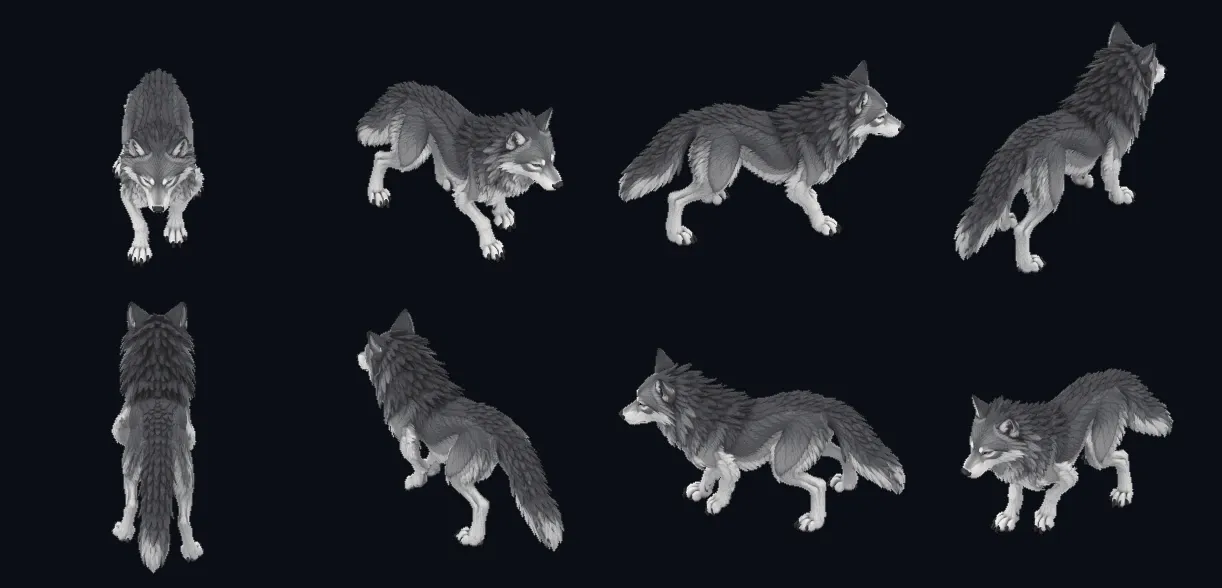
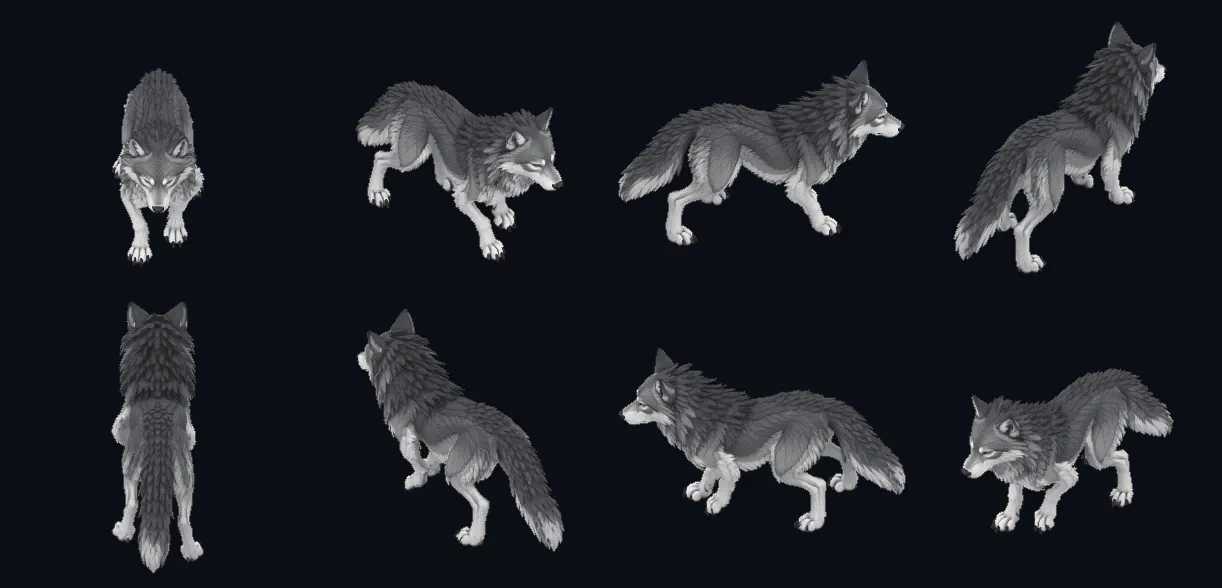
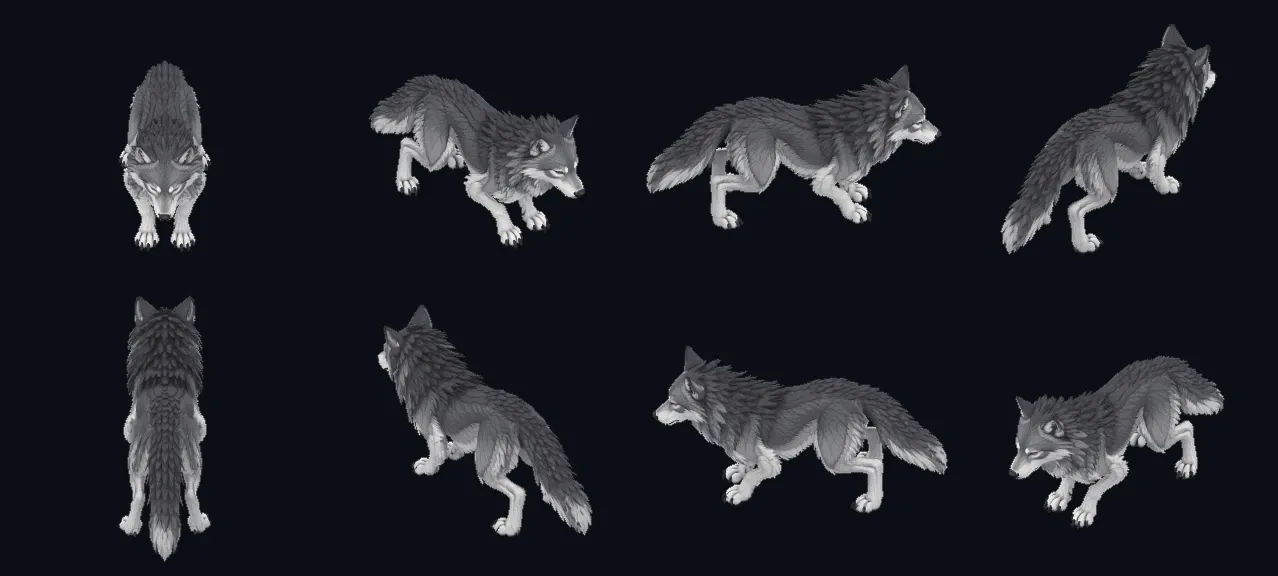
And the cover of this entry is the walk, in all eight directions:
But the interesting part isn’t the result. It’s the five times it was wrong first.
The skeleton was no good
The base model arrived complete, mesh and texture included, with a forty-one bone skeleton that was useless for animating. I rebuilt it natively in Blender, no retargeting, and ended up with twenty-five.
Then it went to twenty-seven, once the shoulder blades had to follow the walk and the pelvis had to rotate on three axes instead of one. And to twenty-eight the day the wolf had to bite: the mouth was closed and had no jaw, so the lower mesh had to be split along the lip, the bone added, the inside darkened and fangs put in.
Read before animating
With the walk working in a single direction, the obvious move was to extend it to eight and carry on. I didn’t. I stopped to study how a canid moves, and that pause is the best thing I did in these two days.
The conclusion fits on one line, and it went into the spec before anything was animated:
Do not use a sped-up walk as a trot or a run.
Walking, trotting and galloping are not the same cycle at different speeds. They are different coordinations: which legs move together changes, how many feet are down at any instant changes, and whether there’s a moment of suspension at all changes. Playing the walk faster doesn’t give you a trot. It gives you a strange walk.
So there are three independent animations — a thirty-two frame walk, a twenty-two frame trot, an eighteen frame gallop — plus four links animated separately for the speed changes: walk→trot, trot→run, run→trot and trot→walk.
The sources are written down, and so are their limits: the literature I found is mostly on domestic dogs, so it serves as a reference, not as truth about wolves. I didn’t copy clinical angles from a dog onto a wolf.
Wrong five times
What followed was a chain of “almost”:
- V3 chained the three gaits and the four links, and it looked fluid. But the wolf ran hunched: the stride never opened up.
- V4 widened the joint range. The gallop gained 16 % of travel per stride, the pelvis stopped sagging and the shoulder blades tucked in less.
- V5 fixed the front legs crossing the chest as they folded. The flexion plane was purely sagittal and pushed the forearm into the ribcage.
- And there was still a break after the elbow and before the paw. I caught it in a still frame, not in motion. It was the carpal joint coming uncoupled from the direction of the forearm during the flight phase. The rig’s maximum angle went from about 65° down to about 29°.
Every version kept the previous one with its hashes. I didn’t overwrite anything: once a version is approved, it gets frozen.
Resting took four attempts
The idle, the howl and the lying down went worse. V1 had the elbows too open and the hind knees pointing outward. V2, which was meant to fix that, made it worse.
That’s where I changed method. Instead of animating again, I made two fixed poses — the howl and the lying down — so they could be judged standing still, without movement hiding the problem. And then it showed: the shoulder blades weren’t coming down with the chest, and the hind legs weren’t folding underneath the body.
The fourth attempt reworked the howl entirely, because the reference was on a rock outcrop: torso angled with the front support higher and the hind legs extended. Howling on flat ground is not the same thing.
The lesson is the same one as always, and I relearn it every month: when an animation isn’t working, the problem is almost never in the animation. It’s in the pose.
A hundred and twenty-eight animations
With the bases approved, the repertoire came out in one pass: sixteen sequences across eight directions at 24 fps, 6,944 images and 168 atlases. Godot loads them as 128 animations.
Two pipeline details that don’t show but cost time:
The palette is fixed, 128 colours taken from four illustrations and the renders, applied to everything. No per-frame palette: if every image picks its own colours, the animation boils.
The canvas grew to 384×384, with thirty extra transparent pixels top and bottom. The north view of the howl was clipping the muzzle on the intermediate frames, because the wolf lifts its head above where it used to fit.
The howl has conditions
Inside the game there are three profiles — young, hunter and alpha — and encounters of one to three wolves. The howl calls in two allies, and here’s the rule I care about:
It only summons if there is a single wolf left alive and it is wounded. One summon per encounter. The ones that arrive never call again, and if you hit it early, the howl is interrupted.
Healthy, it doesn’t call. With companions beside it, it doesn’t call either. The version without conditions was a reinforcement tap; with them it’s a last resort, which is what a howl ought to mean.
The end of the video isn’t scripted: Leo wounds the last wolf, the wolf howls, and two really do arrive.
What I took out
I tried a longer, nimbler lunge: triple the reach, 1.8× the speed, 450 ms of flight. It felt unfair. I revoked the whole thing and went back to the short leap; the only survivor from that version is the dust on landing.
This is easier to write than it was to admit at the time.
What’s missing
None of this has sound yet: not the howl, not the footfalls, not the bite. The wolf is integrated and you can fight it, but the balance hasn’t been tested in play enough, and the campaign doesn’t carry progress between encounters.
The whole wolf, from the model arriving to the video, took two days. The goblin took one. That’s the difference between having a production chain and solving every creature from scratch.