Art
The rebirth in 3D: three turnarounds, two invisible faults and 13,944 sprites
Rebuilding Leo in three dimensions so every new animation comes from the same source. It took three turnaround sheets, and the automated checks found two faults the eye does not catch: 79 clips floating and the chin pointing at the sky.
The PixelLab Leo worked, but every new animation was an independent generation that had to be approved all over again. For a hundred and twenty-two animations, that does not hold.
The decision: rebuild Leo in 3D from the selection artwork, at high quality and without rescaling, to get a model with detail to spare that is then dressed in pixel art. For that you need a turnaround sheet of four views: front, both profiles and back.
It took three attempts.
v01 — rejected by contract
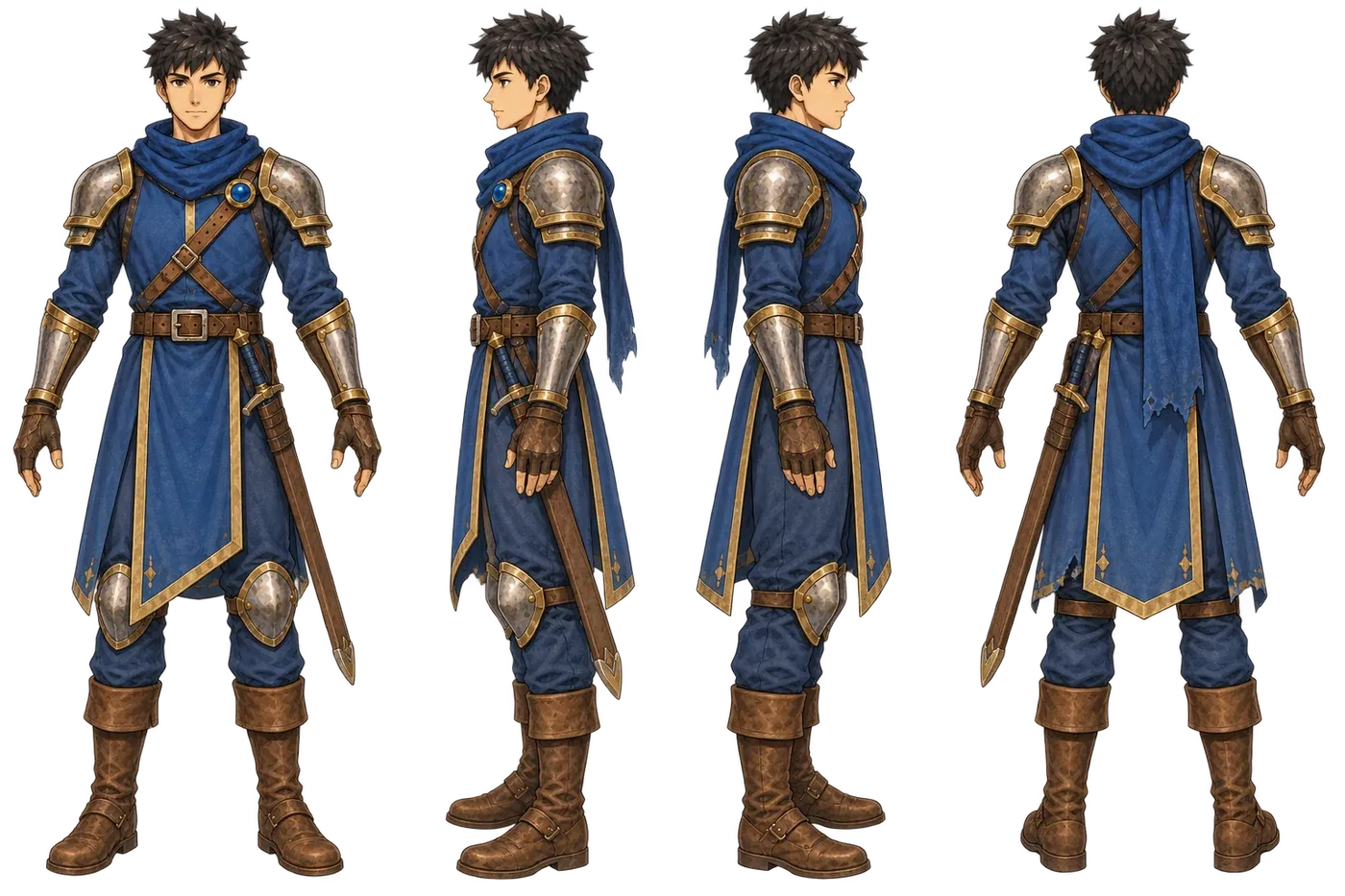
It came out with the sword sheathed. The concept art contract bans weapons in turnarounds, and not out of whim: the 3D generator reads the scabbard as part of the body and then the weapon cannot be separated to animate it. Discarded without discussion.
v02 — rejected by the critique
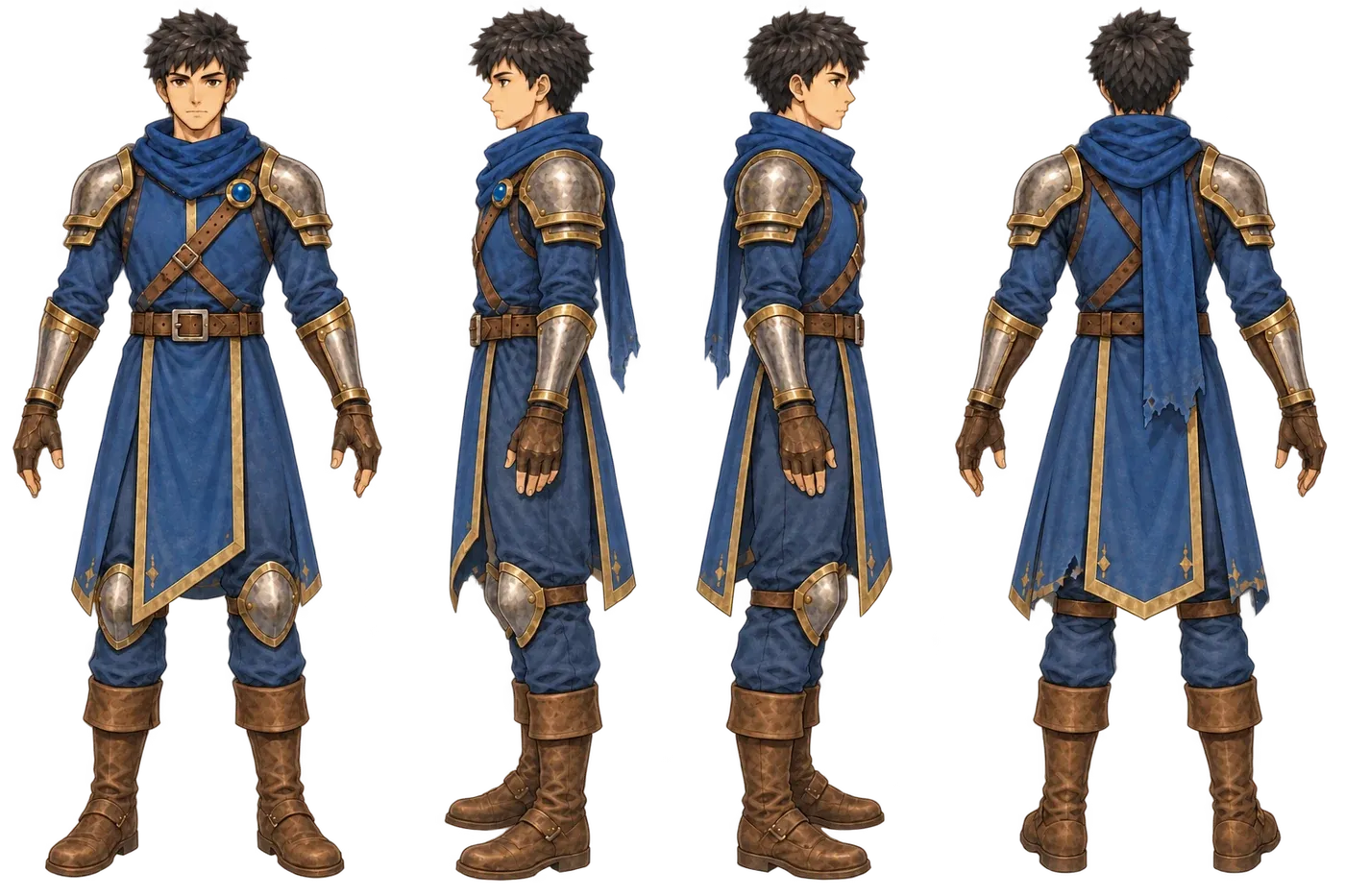
This one came without weapons, and it still fell. Three defects:
- The scarf tail down to the hip, visible on the back and both profiles: close to 35 % of the figure. It is hanging cloth next to the arms: the same category of problem as Serge’s cape, where nearly a thousand foot vertices ended up driven by an arm bone. It is the defect that weighs most.
- The tabard covering the knee guards, which the selection design leaves visible.
- The hair as a round mop of curls instead of spiked locks.
And an objective check finished it off: the legibility gate — a measure of tonal value and the number of colour families — failed it on the back with 0.39.
v03 — approved
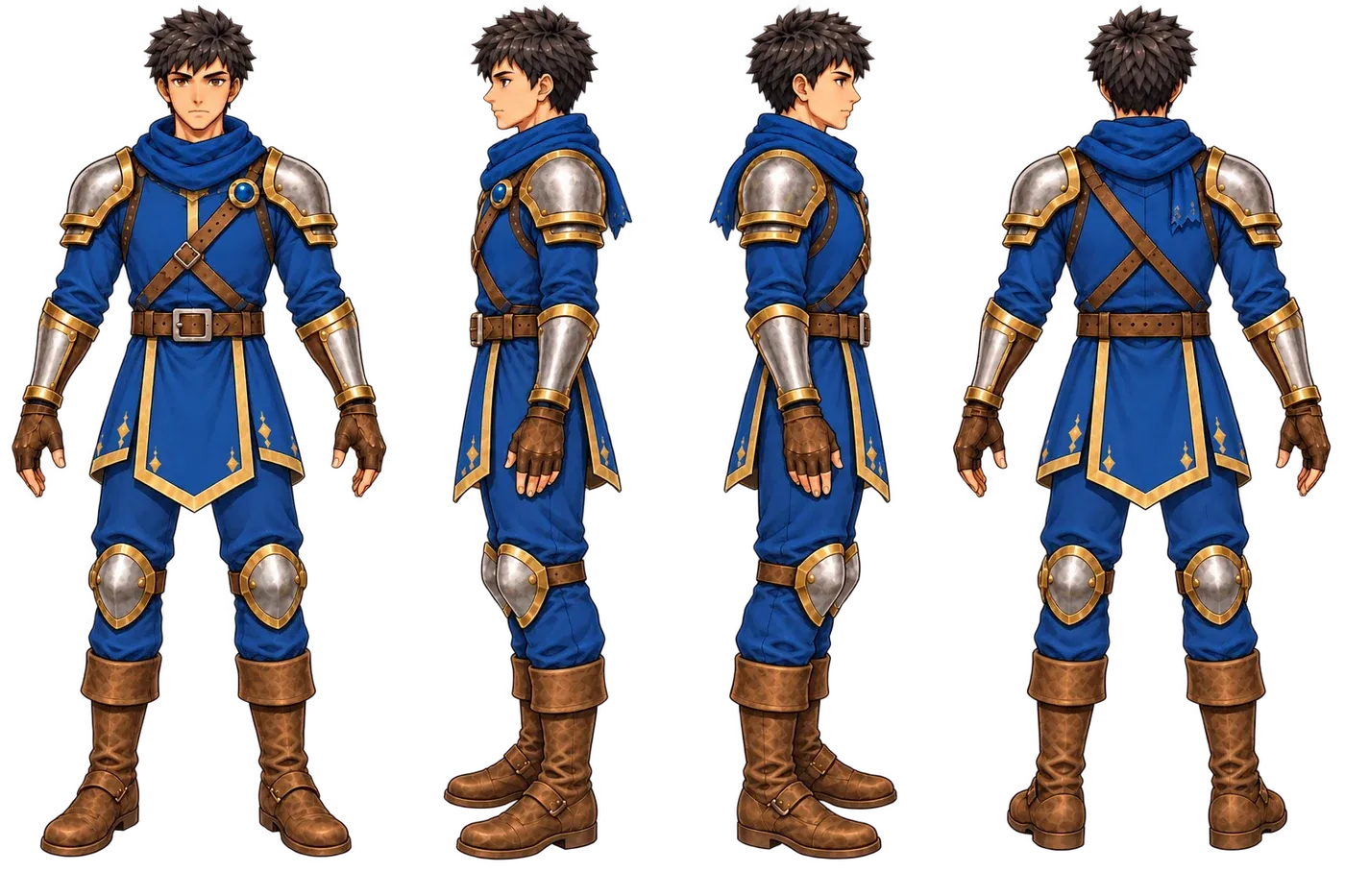
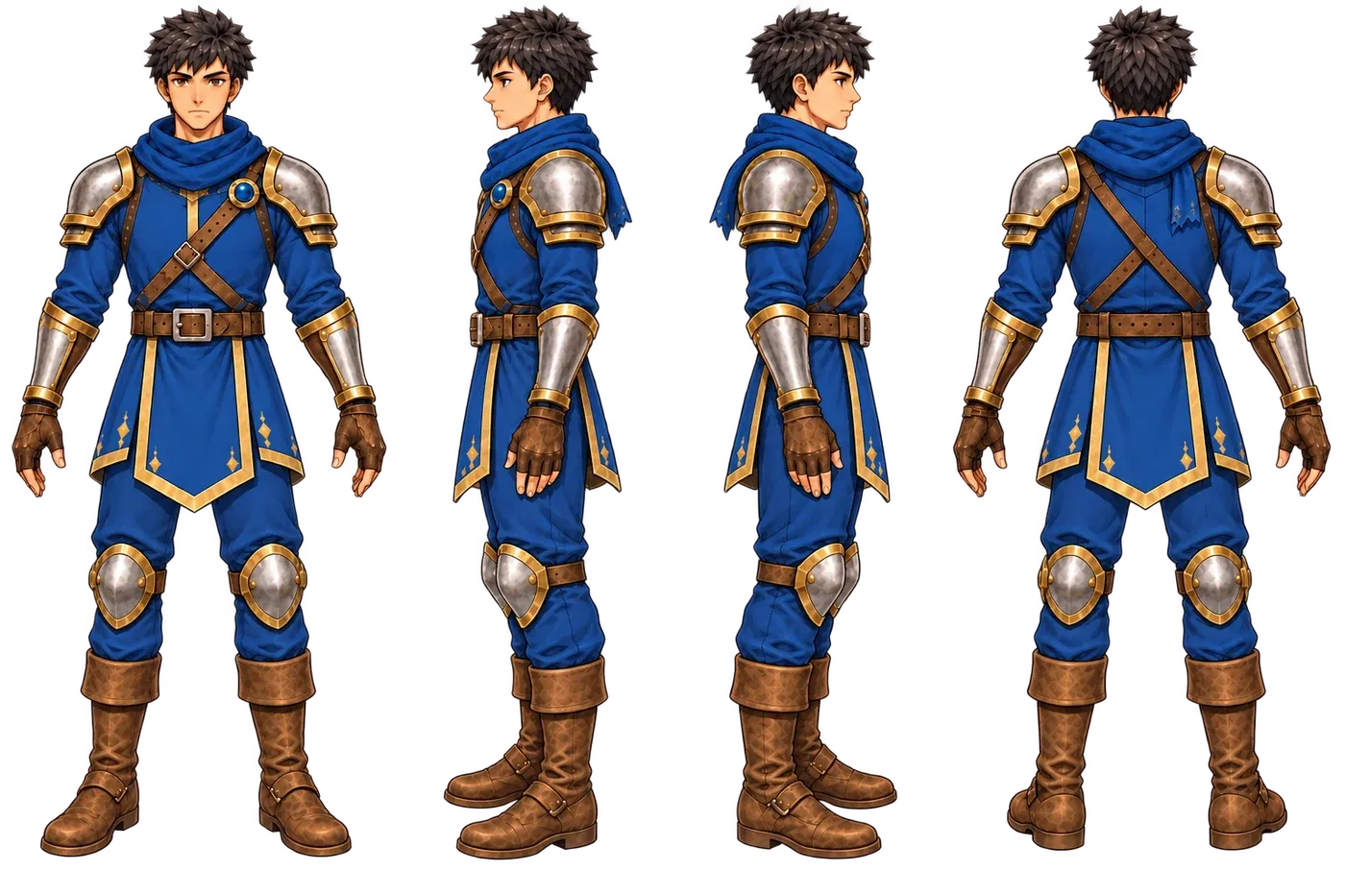
No scarf tail (just the tip tucked at the nape), the tabard above the knee guards, hair in spikes and a gap between arms and torso. The legibility gate opens with margin in all four views: mean value 0.50-0.53, range 0.53-0.58, three colour families.
With that sheet, the birth in 3D: 61,972 faces, an 8192² base texture, 4096² PBR maps, and a 24-bone rig at a real height of 1.75 m. Forty-five credits in total.
What 3D broke, and how it showed
Having the model is not having it solved. Feeding it the animations, the automated check found two faults the eye struggles with:
- 79 of 120 clips were floating. Leo sat 32 cm off the ground, lay down at 73 and died at 75. It had not been noticed because the 33 combat clips are all standing.
- The chin pointing at the sky: +23.6° on average, +54° on stairs, and 101 of 122 clips above 15°. At rest the rig sits at 0°, so the transfer process itself was introducing it.
Both were fixed with pipeline stages, not by hand: a new one that anchors the vertical against the floor of the original clip, and one that already existed and had simply never been run on this character. Afterwards: +0.3° on average and no clip above 15.
And back to pixels
The model is rendered and becomes pixel art again: 1,743 frames × 8 directions = 13,944 sprites. This is the walk in profile, enlarged:
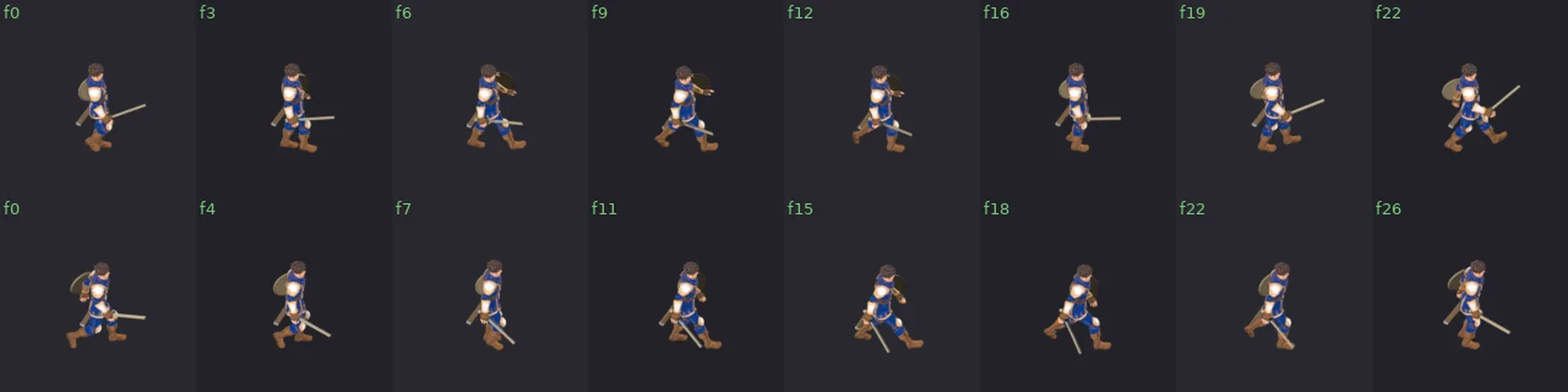
Compared to the PixelLab sheet, the difference is not in the drawing: it is that now every new routine comes from the same source.
The organic pass
With the sprites in the game there was one thing left that numbers do not fix: the walk looked stiff. Correct, measured, and with that puppet hardness that gives away a skeleton behind it rather than a body.
Here is the comparison, from the front. On the left what was there; on the right, after the pass:
And diagonally, which is where it showed most:
The silhouette narrows, the shoulders stop being square and the arms hang instead of swinging along. It is a small change in each frame and an enormous difference as a whole: the one on the right walks, the one on the left slides.
And this is how it ended up, in both directions: